
Past recommended reading directory
What Could a “Formidable” El Niño Mean for New Zealand Avocado Growers?
Recommended reading: What Could a “Formidable” El Niño Mean for New Zealand Avocado Growers?
Avoscene June 2026
Phillip West, Research Manager, NZ Avocado
New Zealand meteorologists are warning that winter 2026 may mark the beginning of a potentially significant El Niño event, with some climate models suggesting it could become one of the stronger events seen in recent decades. El Nino and La Nina have been described as drivers of weather. A bit like our son driving the tractor on the orchard vs our daughter; both with very different driving styles. So, what might we expect? Perhaps a different route to were we’re going but definitely a few different things to keep an eye on to stay on track.
Recommended reading is an online article from Earth Sciences New Zealand, titled “From our forecasters: Winter 2026 may see the start of a formidable El Niño event”.
For New Zealand, El Niño years often bring patterns with high pressure systems more likely sitting over Australia and low-pressure systems more likely over New Zealand. This results in south-westerly and westerly airflow being more common often leading to reduced rainfall across the upper North Island and eastern regions. South-westerlies can be associated with colder temperatures but rather than Niwa forecasting a cold winter they think it is more likely that we may have a cold month or short periods of cold, but winter temperatures are expected to remain near average overall.
Forecasts are not certainties
Importantly, meteorologists stress that ENSO is only one driver of New Zealand weather patterns. Not every El Niño event behaves the same way, and local weather conditions can still vary considerably between regions and orchards.
However, the current forecast models show a strong consensus that El Niño conditions are likely to develop during winter 2026, with more than a 60% probability of the event becoming “strong” by spring.
That means now is a good time for growers to think proactively rather than reactively.
Key questions growers may want to ask now
- Is irrigation infrastructure operating at full efficiency, or will it be by spring?
- What soil moisture resilience actions are available if it looks like Spring/Summer are going to be dry? E.g. mulch availability, irrigation.
- Are shelter systems adequate for stronger/different wind exposure, particularly to the west and southwest?
While no forecast is perfect, understanding the potential implications of El Niño may help growers make earlier and more informed management decisions for the season ahead. Stay informed and educated so you can make your own decisions of what is appropriate for your own orchard.
Machine learning predicting ‘on’ and ‘off’ seasons
Recommended Reading: Machine learning predicting ‘on’ and ‘off’ seasons
Avoscene March 2026
Phillip West, Research Manager, NZ Avocado
Artificial Intelligence (AI) seems to be the buzz word at the moment with promise of huge efficiency gains, new business opportunities and potentially replacing some roles. Where’s the application for avocados you may ask? A case study out of South Africa provides an exciting example relating to crop estimation without a single person needing to set foot in an orchard.
AI or aspects of it allow large sets of data to be sifted through to find helpful information. In this example, freely available satellite imagery and weather variables were assessed to identify the variables associated with predicting ‘on’ or ‘off’ cropping. The model built with these variables accurately predicted ‘on’ and ’off’ cropping 88% of the time.
Why is this helpful for growers? Understanding if an orchard is in a on or off season is a critical aspect in crop estimation. The fact it can be collected at a block level without anyone needing to visit the orchard means there is huge labour savings and crop estimates could start to be collected at a national level almost at the click of a button. There are some limitations, including the need to have historic yield information to train the models but once the model is built, feeding additional seasons data into the model should improve accuracy over time.
Beyond the direct application of this work, it highlights the potential of AI to analyse large sets of variables to identify the factors that are most relevant to a particular outcome. The outcome could easily be fruit quality in market or orchard yields. Both of which we have started to look at using machine learning as well as crop estimation.
Free satellite imagery and some simple weather variables were used to build a model that could accurately predict ‘on’ and ‘off’ cropping 88% of the time.
Some of the most important variables identified were the bearing index (a measure of swing in yield from one season to another), yield in the year prior, vapour pressure deficit (VPD) maximum and minimum temperatures in winter and over flowering and canopy reflectance indices associated with tree canopy characteristics. An alternate bearing block is more likely to stay alternate and a low yield is likely to be followed by a higher yield the following season. Interestingly a high average maximum temperature in June was associated with blocks more likely to go into an ‘on’ season. High VPD or drying air was also associated with ‘on’ seasons. Cooler temperatures through July and through flowering were associated with ‘off’ seasons.
We have been working with Moshiur on assessing satellite-based crop estimation in New Zealand with some promising results. We will publish an update once the season has finished and we have reconciled production data for orchards in the 2025-26 season.
The recommended reading article is available online:
Rahman, M., Robson, A., Bekker, T. (2025). Machine learning approaches for assessing avocado alternate bearing using Sentinel-2 and climate variables—A case study in Limpopo, South Africa. Remote Sensing, 17, 3935
Lessons from California — Optimising Irrigation in Avocado Orchards
Recommended Reading: Lessons from California — Optimising Irrigation in Avocado Orchards
Avoscene December 2025
Phillip West, Research Manager, NZ Avocado
Irrigation comes with very real electricity costs and often an additional cost of the water itself. And while irrigation is a cost it is also essential for fruit sizing, nutrient uptake and tree health, making its precise management important for an orchards bottom line.
When trying to optimise irrigation, it can pay to look to regions where water is far more expensive and strictly regulated. A recent study from California, “Quantifying evapotranspiration and crop coefficients of California ‘Hass’ avocado affected by various environmental and plant factors” by Montazar and colleagues (2025), provides valuable insights for any grower wanting to get more from every litre of water.
California’s avocado industry faces severe pressure from high water costs, salinity, and limited supply — challenges that force growers to refine irrigation. The research team measured actual crop water use and developed updated crop coefficient (Kc) values for ‘Hass’ avocados across five regions. They found that orchard water use varied widely with slope, canopy cover, soil type, and local climate — ranging from about 700 mm to just over 1,000 mm per season. Teruko Kaneko did some similar work in New Zealand and found water use varied between regions and with different crop loading. NZ Avocado use the crop factors Teruko developed to calculate the soil moisture updates shared regularly via Avoconnect.
This study reinforces a simple truth: water demand is variable from orchard to orchard. By using soil moisture monitoring to understand how much water trees actually use and how this changes through the season, growers can fine-tune irrigation schedules to save costs, avoid stress, and produce consistent, high-quality fruit.
Both recommended readings are available online
Montazar, A., Faber, B., Corwin, D., Pourreza, A., & Snyder, R. L. (2025). Quantifying evapotranspiration and crop coefficients of California ‘Hass’ avocado affected by various environmental and plant factors. Agricultural Water Management, 313, 109481.
Kaneko, T. (2020). ‘Hass’ avocado tree water use and the effects of water stress on fruit development. PhD thesis, University of Waikato, New Zealand.
Value from some of the smallest workers on the orchard
Recommended Reading: Value from some of the smallest workers on the orchard
Avoscene September 2025
Phillip West, Research Manager, NZ Avocado
Insects are some of the hardest workers on your orchard, from pest control to pollination. This issues recommended reading is two publications that focus on pollination. Who are doing the job and what do they need from your orchard to do it effectively?
- Evans LJ et al. (2011). The role of insect pollinators in avocado pollination in New Zealand and Australia. Proceedings of the VII World Avocado Congress.
- Read SFJ et al. (2017). Insect visitors to avocado flowers in the Bay of Plenty, New Zealand. New Zealand Plant Protection 70: 38–44.
Avocado pollination is a little different to many other crops. Each flower opens twice: first in the female phase, when the stigma is receptive to pollen, and then in the male phase, when pollen is released. For successful pollination, pollen from a male-phase flower needs to be transferred to a receptive female-phase flower. This process can happen within the same tree (close pollination) or between trees and cultivars (cross-pollination), and timing is everything. Weather conditions, cultivar type, and orchard layout all influence how much overlap occurs between male and female phases.
Honey bees are the main pollinators in New Zealand avocado orchards, making up over 90% of recorded flower visits in Bay of Plenty surveys. However, other visitors such as bumblebees, flies, and beetles also contribute. Their role can be especially valuable under cooler, overcast, or windy conditions when honey bee activity declines. Overseas studies show that a wider diversity of pollinators can improve the chances of successful pollen transfer throughout the day and under varying weather conditions.
The Evans LJ et al. (2011) paper highlights that low visitation rates and low numbers of pollen grains deposited on female flowers may be limiting fruit set on some New Zealand and Australia orchards. Even when insects visit female flowers, many carry surprisingly little avocado pollen, often because male flowers weren’t open nearby at the time. This highlights the importance of orchard design (e.g., well-placed polliniser trees) and management (e.g., hive placement and stocking rates) to maximise overlap between male and female phases and encourage cross-cultivar foraging and effective pollen transfer.
Take-home message:
- Pollination success depends on insect abundance, activity, pollen availability, and timing of flower phases.
- Honey bees dominate avocado pollination in NZ, but other insects also play a role, particularly in suboptimal weather.
- Good orchard design with polleniser layout and pollinator management can improve fruit set, especially in “off” flowering years.
Understanding copper persistence in wet conditions
Recommended reading: Understanding copper persistence in wet conditions
Avoscene June 2025
Phillip West, Research Manager
Copper is currently the only fungicide registered for avocados in New Zealand. Maximising its effectiveness—especially under wet conditions—is crucial for managing fungal disease risk and minimising unnecessary applications.
A recent study by Zespri Innovation and research partners, while focused on kiwifruit (SA management), offers valuable insights that are broadly relevant to avocado production. The research explored how different copper products perform over time, the role of rainfall, and the importance of bioavailable copper—the fraction that actually inhibits disease.
The article was kindly made available by the New Zealand Kiwifruit Journal and is available on the NZ Avocado website under “Research reports” titled “Bioavailable copper for PSA management – NZ Kiwifruit Journal”. You will need to log into the website to be able to access it.
Key takeaways for avocado growers:
- Rain matters:
Bioavailable copper (the active portion that protects the plant) typically peaks 2–7 days after spraying. Heavy or frequent rainfall rapidly reduces this protective layer, which means re-application after rain is often necessary to maintain disease control. - Product choice impacts persistence:
Different copper products release and retain bioavailable copper differently. For example, Nordox was slower to release but retained activity longer, whereas Kocide Opti and ChampION++ released more initially but were more affected by rainfall. Although avocado leaf and fruit surfaces differ from kiwifruit, the same general trends in product behaviour likely apply. - Target the right timing and tissue:
The article highlights the benefit of targeting young kiwifruit leaves as these are particularly susceptible to PSA infection. Fungal infection of avocados is believed to be possible year round based on spore germination temperature studies. However, a likely important window is early fruit development in spring, when fruit rapidly expands, diluting copper coverage, and the usually warmer wet conditions are conducive to fungal infection. - Interactions with other sprays:
Co-application with seaweed products (like Acadian) drastically reduced bioavailable copper—by more than half in some cases. A three-day gap between applying copper and seaweed-based products is recommended to prevent reduced efficacy. - Check your pH:
Acidic spray solutions tend to increase bioavailable copper, particularly with products like Nordox. While this might improve efficacy, it may also increase phytotoxicity risk. Keeping tank mix pH near neutral is a prudent precaution. This is why copper should not be applied with phosphonate sprays as the lower pH can cause phytoxicity.
Bottom line for avocado growers:
This research highlights the importance of spray timing, reapplication after significant rain, product choice, and careful mixing to get the most from copper sprays. While the exact numbers from kiwifruit don’t directly transfer to avocados, the core principles offer a sound foundation for more effective and sustainable use of copper fungicide in our orchards.
Reference
NZ Kiwifruit Journal, Apr/May 2025, pp.27–30. “Bioavailable copper for PSA management”
Improving avocado quality through mineral nutrition
Recommended Reading: Improving avocado quality through mineral nutrition
Avoscene March 2025
Phillip West, Research Manager, NZ Avocado
Fruit quality and fruit robustness is crucial to meet customer demands and will be even more important in the season ahead as we look to send more volume to more distant markets.
The AV19004 Final Report, titled Improved Fruit Quality and Robustness in Avocado Supply Chains (Mineral Nutrition), explores how pre-harvest mineral nutrition impacts the postharvest quality of avocados. Conducted as a six-month literature review, the study analysed over 180 scientific and technical sources to provide Australian avocado growers with evidence-based strategies for optimizing fruit robustness.
The report identifies calcium (Ca) as a critical nutrient for avocado quality, recommending sufficient Ca application during early fruit development while balancing nitrogen (N), potassium (K), and magnesium (Mg) levels to prevent quality defects like body rots and flesh discoloration. Other key recommendations include selecting appropriate rootstocks, monitoring fruit tissue nutrient levels, and optimizing irrigation and canopy management.
Additionally, the report highlights research gaps, such as understanding how environmental factors influence fruit nutrient status and developing rapid diagnostic tools for monitoring avocado nutrition.
This report is helpful reading for avocado growers, agronomists, and industry stakeholders to understand the complexity of optimising fruit calcium to enhance fruit quality and meet consumer expectations.
The report can be found on Horticulture Innovation Australia’s website under ‘Growers > Help your business grow > Research reports, publications, fact sheets and more > Completed projects > AV19001’
or by going to: https://www.horticulture.com.au/growers/help-your-business-grow/research-reports-publications-fact-sheets-and-more/av19004/
Guidelines for Soil Nitrogen Testing and Predicting Soil Nitrogen Supply
Recommended Reading: Guidelines for Soil Nitrogen Testing and Predicting Soil Nitrogen Supply
Avoscene December 2024
Phillip West – Research Manager, NZ Avocado
Excessive nitrogen fertiliser is a waste of growers’ money, correlates with poor fruit quality and presents an environmental risk. Nitrogen is essential to support yields, so how much is too much and how can we plan our fertiliser applications more accurately? We often focus on the nitrogen we add as fertiliser but the organic matter of our soils is a significant source of nitrogen that is not as easily quantified. This issue’s recommended reading is a fact sheet from Plant & Food Research that provides essential insights into soil nitrogen testing, crucial for optimising fertiliser use in crop production. While avocados aren’t the crops used in the fact sheet, it highlights some important aspects of nitrogen management. It outlines two key nitrogen forms: Mineral N (immediately available nitrogen) and Mineralised N (released from organic matter during the growing season). The document details methods for testing these nitrogen types, including the innovative Potentially Mineralisable N (PMN) test, and explains how to estimate nitrogen supply to forecast fertiliser needs more effectively.
Key takeaways include:
- The importance of sampling soil in spring if wanting to accurately assess nitrogen levels.
- Practical formulas for calculating total nitrogen supply from different New Zealand soils based on soil test results.
For anyone trying to optimize their nitrogen management, this document is a valuable resource. It enhances understanding of soil nitrogen dynamics and supports sustainable farming practices.
[Shadow box] The full guidelines can be found on the Plant & Food Research website under ‘Soil nitrogen testing and predicting nitrogen supply’.
Frosts
Recommended Reading: Frosts
Avoscene September 2024
Phillip West – Research Manager, NZ Avocado
Frosts can negatively affect avocado trees in a very visual way. Brown flower buds and brown speckling on leaves, particularly young ones, are a sure sign that a frost has impacted flowering and the photosynthetic potential of your trees. Protecting young trees with frost cloth is a labour intensive job but this issues recommended reading highlights the benefits that frost cloth can provide. It was published in February this year in the ‘Trees’ journal and is titled ‘Covering young avocado ‘Hass’ trees with high-density shading nets during the winter mitigates frost damage and improves tree performance’. You can find it by searching for the title online.
The authors carried out a trial over 2 years with some young trees covered with a 60% shade net in the winter months. They documented different tree performance metrics and showed while the shade cloth reduced light interception in the winter months, the trees performed better when covered. In the first year, which experienced more severe frosts, 93% of the examined floral buds were severely damaged in the uncovered control, compared to only 4% in the covered trees. Covering the trees reduced light interception but carbon dioxide fixation and stomatal conductance was not affected. This means leaves on covered trees were harvesting just as much carbon as the uncovered ones despite not getting as much light. When shade cloth was removed they observed an initial drop in carbon dioxide fixation but this recovered to be higher than the uncovered trees through the summer months as well. So it looks like covering young trees in winter is not just about getting them through the winter unscathed from frosts; it also sets your trees up for high performance through summer months as well.
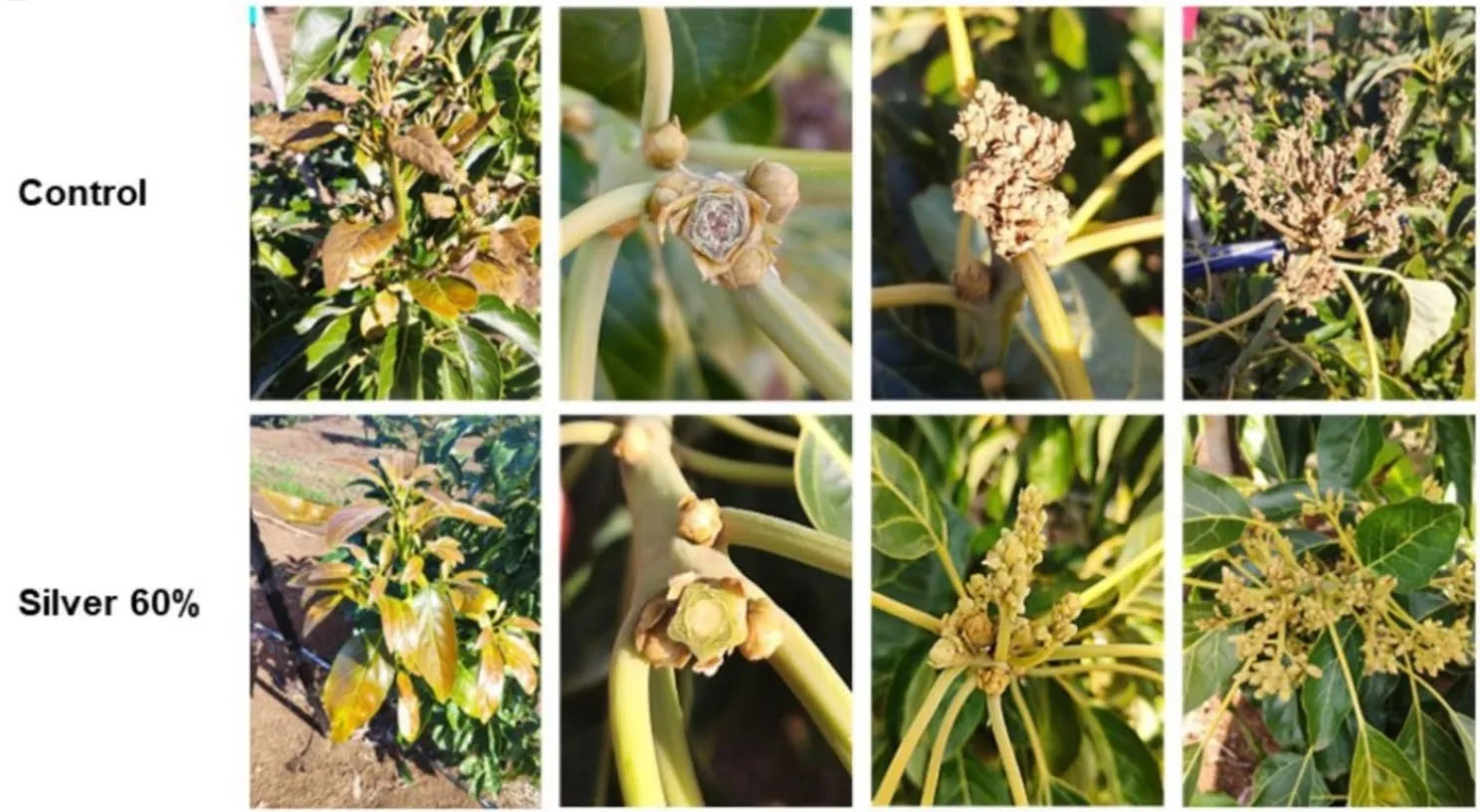
Figure‑1. Figure from Rubinovich et al, 2024 showing typical frost damage observed on the uncovered ‘Control’ trees and the shade net covered trees ‘ Silver 60%’
Fertiliser inputs
Recommended reading
Avoscene June 2024
Phillip West, Research Manager, NZ Avocado
There is currently a lot of discussion around fertiliser inputs. “How much is too much before fruit robustness starts to suffer?” “How much do I need to apply to get good yields?” “How little can I get away with to save on my costs?” “What are the chances that the fertiliser I’m applying might end up in water ways?” All good questions that growers should be asking.
The NZ Avocado Research team have undertaken some research in this area and are starting to understand how much is removed in crop load and what our leaching risk might be. This is all about understanding how much nutrients an avocado tree needs and when it needs them so growers can get the most value out of their fertiliser with minimum risk.
The recommended reading for this issue of avoscene is an article from South Africa written in 2000 by Snijder and Stassen titled ‘Macro nutrient accumulation and requirement of Hass avocado trees’. You can find it online by searching for the title.
It is a good study of how much nutrients are incorporated into a tree as it grows and what tissue it ends up in. Beyond the academic endeavour, it attempts to translate this into useful information for a grower in the form of how much nutrient (fertiliser) should be applied and when. On their fertile soils, application of 90kg nitrogen/ha/year they think is enough to support a 20t/ha crop (equivalent to 333kg/ha/year of CAN fertiliser). The suggested application timing might not be quite right for New Zealand as the paper suggests 20% of nitrogen should be applied in July/August winter months but the concept of timing application with, or just before, phenological stages of the trees growth is a good one.
Enjoy the read and watch this space as our own understanding of fertiliser optimisation grows for New Zealand conditions.
Canopy management
Recommended reading: Autumn 2024
Avoscene March 2024
Phillip West, Research Manager, NZ Avocado
Many growers will not be shy to take out their chainsaws this autumn and winter and lop off a few tree limbs to vent some frustration. If you can do it in a way that improves yield, picking and spray efficiency, and fruit quality, even better!
This issue’s recommended reading is a fantastic review of published material about avocado canopy management from 2022. Helen Hoffman is a Senior Horticulturist for the Queensland Department of Agriculture and Fisheries. Helen provides a fantastic overview of canopy management, addressing the following concepts:
- The importance of canopy management to profitability,
- avocado physiology and implication for canopy management,
- canopy management principles,
- a history of trends in canopy management,
- planting density,
- tree shaping,
- canopy manipulation,
- use of plant growth regulators ,
- and even touches on some of the new technologies that may help with decision making in future.
The article can be found on the NZ Avocado industry website by searching “Canopy management literature review 2022”.
Helen’s review does not identify a single ideal approach but rather different pathways to achieve the management principles; optimising light interception, ensuring light distribution in the canopy, optimising structure to promote operational efficiency. Interestingly these are similar to the principles defined from successful New Zealand pruning approaches of pruning for light interception, spray and harvest access, rejuvenating the tree and managing crop load.