
Mirid control in spring 2026
Mirids (species in family Miridae) were suspected of damaging flowers and reducing fruitset and yield in avocados. NZ Avocado – in collaboration with growers, AvoGreen operators, packhouses, and BSI-Plant and Food Research – set up a research programme to understand the impact of mirids on avocados and develop an IPM based control strategy. The mirid team has conducted trials across spring 2024 and 2025 to assess mirid impact on fruitset/yield and to assess the efficacy of Pyrethrum sprays in controlling mirids.
Results from both 2024 and 2025 trials indicate that mirids cause damage and reduce fruit set and yield in avocados.
The team also organised mirid monitoring in avocado growing regions with the help of avogreen operators and grower monitors across spring 2024 and 2025. The monitoring revealed that there is a presence of mirids across all the main avocado growing regions. Massey University PhD student studying mirids has also looked at the efficacy of various monitoring techniques which revealed that visual monitoring is the most effective technique for monitoring mirids.
The team also did a species identification exercise using specimens collected during mirid monitoring across spring 2024 and 2025 which indicate that the mirids present in avocado orchards belong to a single species, Diomocoris ostiolum.
Results from trial, monitoring and species ID work will be foundational in development of an IPM based control strategy for mirid control.
Mirid control 2026
Mirids are not formally a part of the official AvoGreen programme. However, NZA recommends monitoring and spraying for mirids where required in 2026.
Monitoring:
NZA recommends visually monitoring for mirids, using your regular AvoGreen monitoring trees for each sample area across your orchard.
Timing: NZA recommends monitoring for mirids weekly from pre-flowering (or early flowering) until the end of flowering.
Number of trees: Use the same number of trees as per your current AvoGreen monitoring protocol in each sample area.
Number of flowering shoots: Monitor a minimum of 5 flowering shoots per tree. Visually examine the flower panicles and approximately 25 cm of the shoot below the flower panicle for the presence of mirids.
Monitoring documentation: Please do not record mirid monitoring observations on your regular AvoGreen monitoring sheets.

Spraying
Where mirids are present or there is a history of mirid damage, NZA recommends applying two Pyrethrum sprays at a maximum rate of 150ml/100L in early and mid-flowering to control mirids
in avocado orchards.
Spray product: Spray efficacy results from spring 2024 and 2025 Trials show that Pyrethrum sprays (ZETaPY) are effective in suppressing mirid numbers in avocado orchards.
Spray rate: Based on results from spring 2025 trial work, applying Zetapy at a rate of 150ml/100L provides optimal mirid control – especially under moderate to high mirid pressure.
A spray rate of 100ml/100L may be a viable spray rate; however, a spray rate of 50ml/100L was not sufficiently effective in controlling mirids and is not recommended.
Spray timing: The spray timing here is based on mirid monitoring data collected over last two seasons. Two targeted sprays, one each in early flowering (when nymph numbers are highest)
and mid-flowering (when adult numbers are highest) will give effective mirid control during flowering period. However, a third application may be applied if the mirid pressure continues to be high post the second spray application (Mirid numbers naturally declined by the 3rd spray application in trial orchard).
Other spray products: CAUTION!! NZA has not tested efficacy of any other spray products besides pyrethrum. However, there is anecdotal evidence of tau-fluvalinate (Mavrik) being effective in
controlling mirids. Due to a very long PHI and residue issues associated with Mavrik, it SHOULD NOT BE USED IF THERE IS FRUIT ON THE TREE. If you do decide to use it because you have a fruit free window, the recommendation is to apply ONE Mavrik spray pre-flowering or in early flowering period. NZA is planning to test other spray products in spring 2026 to give growers more spray options for mirid control.
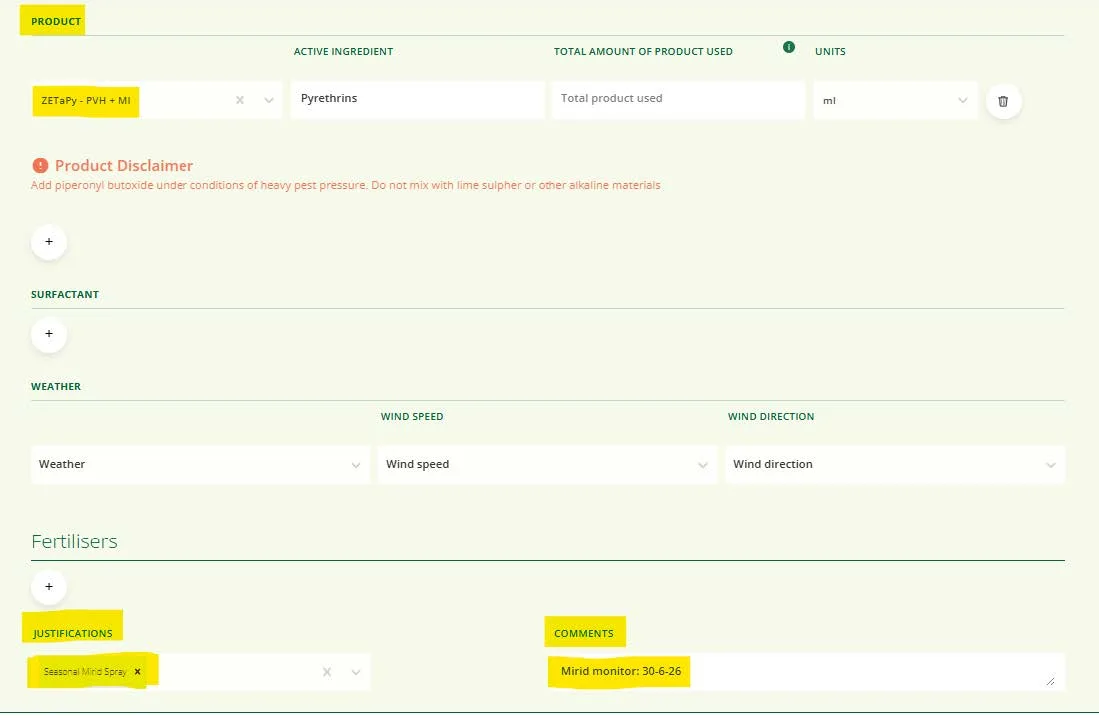
Spray justification: A seasonal blanket ‘Justified Approval’ is now granted to spray for mirids using pyrethrum (maximum 3 sprays) and Mavrik (maximum 1 spray). There is still a requirement to record mirid sprays in the spray diary using the Justification of ‘Seasonal Mirid spray’ from the drop-down box as below. Please add the latest mirid monitor date in the ‘Comments’ box when adding a mirid spray application in the spray diary as highlighted below.
Bee safety consideration: Growers still have an obligation to consider bee safety when spraying for mirids. While bees are present in orchard –
1. Please get consent from your beekeeper before any spray application
2. Spray in evenings only when bees have returned to their hives
3. Cover beehives prior to spraying if your beekeeper requires this
Future work: Future work in spring 2026 will look at developing economic spray thresholds, added soft chemistry options, improved monitoring methodology and alternative control options.
If you have any questions or comments, please contact Sunmeet at sunmeet.bhatia@nzavocado.co.nz